 Nicholas Shore
I help you scope your manufacturing requirements, identify suitable contract partners in the German-speaking and wider European market, and translate your formulation into a production-ready brief — batch size, equipment compatibility, packaging constraints. By now many toll manufacturers offer regulatory packages along with the manufacturing itself. However, it is still essential to have the competence on hand to prepare the necessary data and double-check the toll manufacturer's output. In the end, YOU are responsible for compliance.
Below are the areas where most of the scoping effort pays off, and where I most often see teams underestimate the work involved.
Product specification and quality control

The spec you give the contract manufacturer is the spec they hit — not the intent behind it. Will your production be a regular task or a single run?
A few areas usually worth tightening before sending an enquiry:
- Raw-material and in-process specifications alongside finished-product specifications. How is raw material quality control handled?
- A separate quality agreement alongside the commercial contract, defining release responsibilities, sampling and retain samples, and the agreed route for out-of-spec batches.
- Method alignment between your QC and theirs — which methods, which instruments, which reference standards — to head off "passes here, fails there" disputes once volume picks up
- Over-speccing vs under-speccing: It would be a major trap to simply trust a toll manufacturer's claims for quality. At the same time, over-speccing your products and requiring lengthy quality control after every production run will drive up costs and increase time to delivery. Finding the right balance between QC and efficiency of operation is a key question that requires some experience to get right.
Scheduling, reliability and flexibility
Toll manufacturers sell capacity. The useful questions are about whose capacity you're sharing it with, and what happens when something goes wrong:
- Real lead times versus advertised lead times, and how they shift at end of quarter or during another client's busy season.
- Minimum order quantities, and the floor below which they stop being interested in producing for you at all.
- Disruption protocols — what happens when their raw material is late, when a vessel needs unscheduled cleaning, or when a batch fails QC. The first time you find out about their procedure should not be when you're already in stockout.
- Incompatible products on the same manufacturing lines? How are lines prepared before your products are handled? Cross contamination can be a major source of headaches.
Real world example: Volatiles such as alcohols or perfumes being packaged in the vicinity of your packaging lines or raw materials can have significant impact on your packaged product, even when the manufacturer assures that there is ample ventilation.
Packaging and labelling
Packaging and labelling is where regulatory, logistic and commercial requirements collide. A few useful starting points:
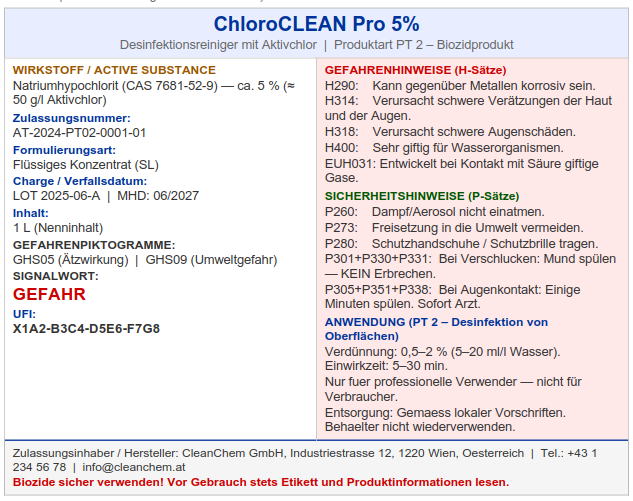
- UN-approved packaging for any product classified as dangerous goods under ADR. (The applicable packaging instruction follows directly from the CLP classification — for example, a CLP Flammable Liquid Category 2 product is ADR Class 3 Packing Group II, which constrains the drums, jerrycans and IBCs you may legally use.)
- CLP label content — pictograms, signal word, hazard and precautionary statements, EUH-statements where applicable, and multilingual content for the member states of placement. The revised CLP Regulation entered into force on 10 December 2024 and brings additional requirements around digital labelling, fold-out labels and distance-selling channels.
- CLP labelling in and of itself creates many new challenges in later iterations, as the mandatory amount of information and mandatory market languages end up at odds with the brand presentation, artwork, and simply available space on the packaging
With ATP24, even JUST the hazard statements and GHS-symbols can use so much space on your label, at the legally prescribed font "x-height", that your label might be already full for smaller bulk sizes between 3 kg and 6 kg.
- Clear ownership of the artwork-print-apply-approve chain. Each handover is a place where errors quietly compound.
Production cost versus logistics cost
The unit price a distant contractor quotes can be tempting, but for liquid chemicals — typically around 0.8 to 1.3 kg per litre — freight is a real share of landed cost:
- Landed cost, not unit price: freight, ADR surcharges, tank or IBC logistics, and the inventory cost of longer lead times.
- ADR adds a layer to road transport: only few logistics partners will be equipped to handle dangerous goods. Some dangerous goods even no longer allow a Limited Quantity amount for simpler transportation.
- Distance also costs in supervision: audits, troubleshooting and joint problem-solving are slower and more expensive when the plant is six hours away rather than one. Personal meetings with partners become a real logistical effort (and expense).
In short, having a competent person by your side to assist you with working out the kinks in your toll manufacturing needs will save you lots of headaches later.